What is School ERP? A No-Nonsense Guide for School Principals
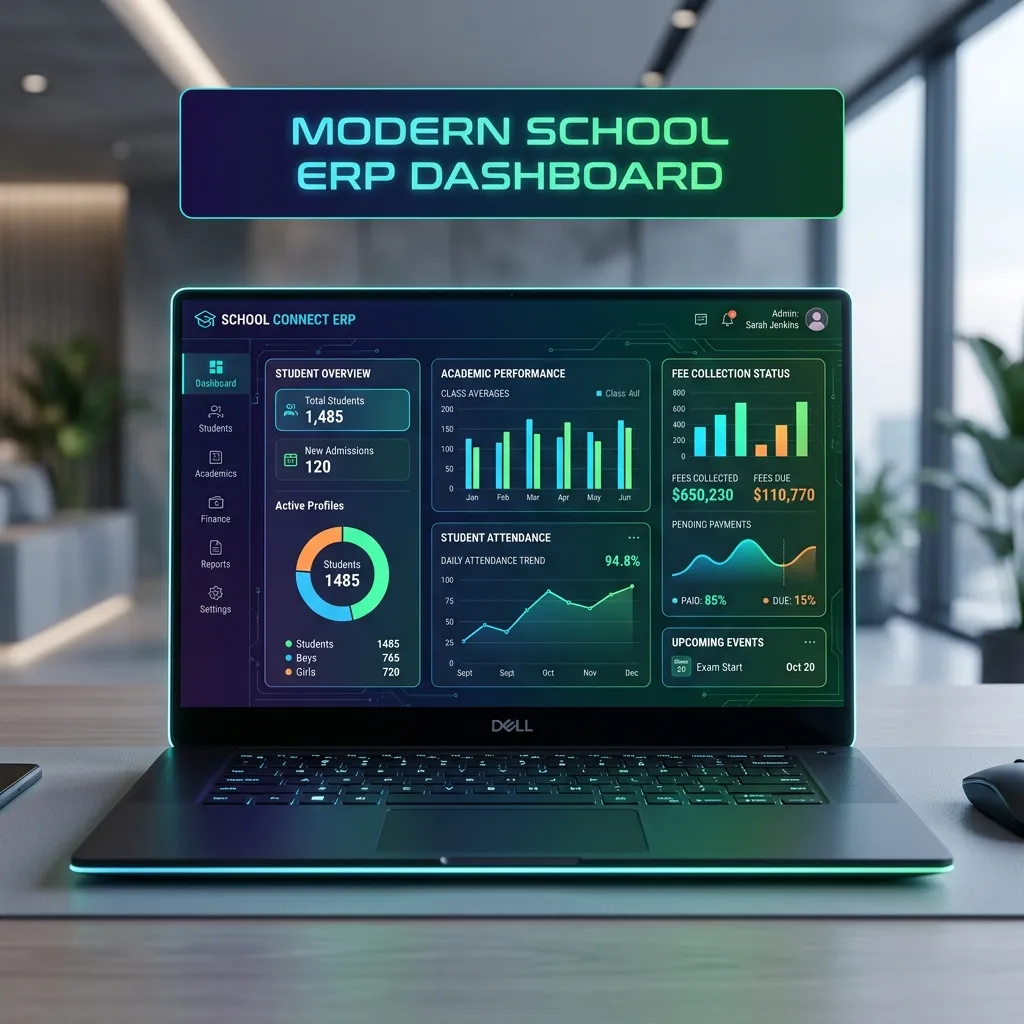
School ERP (Enterprise Resource Planning) is a comprehensive software system that digitizes and connects all administrative, academic, and financial operations of a school into a single centralized platform. By automating tasks like fee collection, attendance tracking, and report card generation, it eliminates manual paperwork and improves communication between parents, teachers, and administrators.
Let me be honest with you.
When I first heard the term "School ERP" about nine years ago — back in 2017 when we were just starting KD Websoft — I thought it was some fancy IT buzzword being thrown around at conferences to impress people. I'm not even joking.
But here's the thing — I was wrong.
After 8+ years of working with hundreds of schools across Rajasthan and beyond, I've come to understand that School ERP is probably the single most practical investment a school can make in 2026.
Okay, What Exactly is School ERP?
ERP stands for Enterprise Resource Planning. The concept originally came from big manufacturing companies who needed to manage inventory, finance, HR, and production all in one system. Schools borrowed the idea. And honestly, it fits surprisingly well.
- 600 students with different fee structures, different sections, different routes
- 40 teachers whose attendance needs to be marked
- Parents calling to ask if their child was absent today
- An exam coming up next week and the timetable isn't ready
- An accountant trying to reconcile fee records from three different registers
Think about everything a school has to manage on any given day:
A School ERP — or School Management Software — handles all of this. Admissions, fees, attendance, exams, marksheets, HR, payroll, library, transport — everything in one platform. Connected. Real-time. Accessible from your phone.
The Problem with How Most Schools Currently Work
The fee accountant keeps records in Excel files with names like "Fee_Final_FINAL_v3_USE_THIS.xlsx". The principal has no idea how many fees are pending. If a parent says "I paid last month," there's a scramble through three different notebooks before anyone can confirm.
The attendance teacher fills a register. At month end, someone manually counts leaves for each student. For 600 students. By hand.
The problem isn't that people are bad at their jobs. The problem is the system — or the lack of one.
What Changes When You Use a School ERP
Fees: Parents receive an automatic WhatsApp message the moment a payment is recorded. The accountant's daily closing takes 20 minutes instead of two hours.
Attendance: Teachers mark attendance on their phones. Parents get an SMS if their child is absent. Monthly reports generate automatically.
Exams: Marks are entered once. The system calculates grades, ranks, and generates marksheets. With AI-powered systems, marks are extracted from scanned score sheets — no typing at all.
HR: Salary slips generate at the click of a button.
Is School ERP Only for Large Schools?
No. I've seen schools with 150 students benefit enormously from switching. The value isn't just in scale — it's in organization. If anything, smaller schools often see a faster transformation.
A Note on AI in School ERP
Some school ERP systems now have AI features built in. The most practical one: AI-assisted mark entry — the system reads a scanned score sheet and extracts marks automatically. For a school running six exams a year for 500+ students, this saves weeks of work.
AI in school management isn't about robots replacing teachers. It's about removing tedious, repetitive, error-prone work so that humans can focus on what they're actually good at.
Final Thought
The question in 2026 isn't "should we use a school management system" — it's "why haven't we started yet?"
If you're still on the fence, ask yourself: how much time did your staff spend last month on tasks that a computer could have done in seconds?
That's your answer.